Why a Long Take Can Change the Feeling of Time
A long take can make ordinary movement feel charged. Learn what to watch for when a sustained shot seems slow, confusing, or unexpectedly absorbing.
The most common mistake with a long take is waiting for a cut to tell you what matters. That habit can make a sustained shot feel dull or confusing, because your attention keeps searching for the editing cues that are not coming. In East Asian cinema, a long take can change the feeling of time by asking you to notice duration, movement, and the shifting life inside the frame.
There is no single effect built into an uninterrupted shot. A character crossing a room may seem calm, trapped, or newly exposed, depending on how the camera moves and what else occupies the image. If the shot feels difficult, the trouble is often a mismatch between the viewing habit you brought and the way the scene organizes attention. These adjustments can help you meet the shot on its own terms.
Why does a long take feel slow?
A shot may feel slow because its action is modest, but duration is not the same as emptiness. The time spent walking, waiting, or completing a small task lets you notice how the character carries themselves and how the setting presses on them. A cut might skip the interval; a long take makes you live through it.
Try tracking one physical action from beginning to end. Notice when a person pauses before opening a door, or whether they keep working after someone enters. Then look for a change in the room: a new person at the edge, a curtain moving, a sound from beyond the frame. The scene may be progressing through attention rather than plot information.
If you keep checking how much time remains, choose one detail to follow instead. A hand, doorway, or patch of light can give your attention a small anchor. Once that detail changes, widen your gaze again. You are not required to find a hidden symbol; simply observing what changes can make the duration feel purposeful.
Why do you miss important action in the frame?
Without a cut to point toward the next subject, your gaze has to make its own route. You may follow the central character and overlook a second person entering behind them, or watch a conversation while a meaningful gesture happens near the edge. That is not necessarily a failure of the scene. The image may be designed to let more than one event coexist.
First, take in the whole composition before choosing a person to follow. Notice the foreground, the space behind the actors, and the openings through which someone might arrive. Then watch the camera’s movement. A slow pan can reveal a relationship between two parts of a room; a fixed camera can make a character’s movement through the frame carry the change instead.
For a useful viewing adjustment, let your gaze move after the scene gives you a reason. A voice from offscreen, a glance, or a shift in posture may redirect attention. If you decide in advance that the protagonist must be the only important subject, you can miss how the shot distributes attention across a family table, a shop floor, or a crowded street.
Why does a moving camera make the scene harder to read?
Camera movement can seem like an instruction to look everywhere at once. In fact, its direction and pace often establish a path through the space. A camera following someone down a corridor keeps their movement continuous; a lateral drift may reveal people or objects that were previously hidden. The key is to notice what the movement connects, not merely that the camera is moving.
Start by asking what stays in relation as the camera moves. Does the lens remain close to one character while the background shifts? Does it leave that person behind and settle on someone else? Does a doorway become visible only after the camera passes it? These choices can change who seems to have room to act and who appears watched.
When motion feels busy, stop trying to identify every object. Follow the camera’s broad path, then note the moment it pauses or changes direction. That moment can clarify what the movement has been preparing you to see. A tracking shot and a pan may both move, but their effects differ: one travels through space, while the other turns from a position. A scene may also combine movement with a stationary frame, so judge the actual shot rather than assigning it a label too quickly.
Why does a quiet shot still feel tense?
A still camera can hold tension without showing obvious action. A person may wait at one side of the frame while an empty entrance remains visible; the possibility of someone arriving can make the interval feel charged. Sound matters too. Footsteps beyond the image or a machine continuing in the background can make an apparently settled composition feel unsettled.
Try separating what you can see from what you can hear. Identify the visible actions, then listen for sounds whose source is outside the frame. That distinction helps you notice how the shot uses unseen space. In some scenes, the screen does not show the event you are anticipating; instead, it gives you time to experience the anticipation itself.
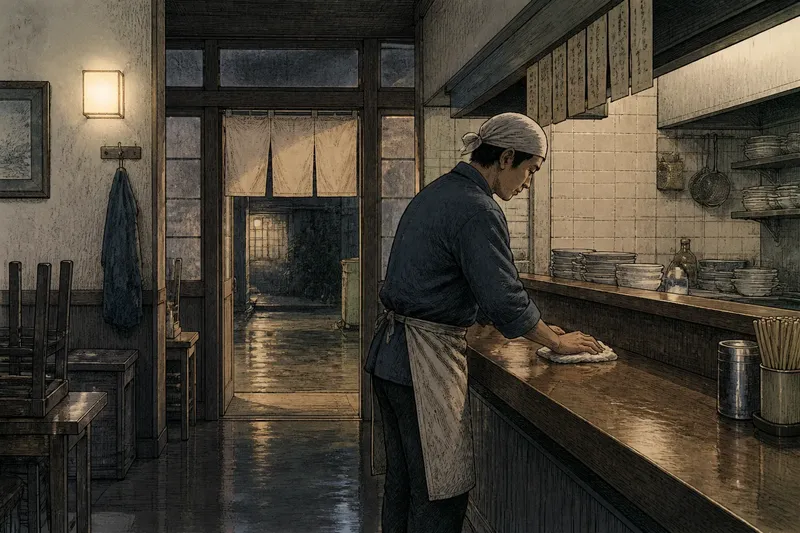
Imagine a fictional scene in which a cook stands alone in a small restaurant after closing, wiping the same counter while the camera holds its position. A chair scrapes somewhere beyond the doorway, but no one enters the image. If you watch only for visible action, the moment may seem to stall; if you attend to the sound, the open doorway, and the cook’s pause, you can notice how expectation has become the scene’s main movement. That is an invented viewing situation, not a claim about a particular film.
What should you ask when a long take loses you?
Does the shot give me a clear place to look?
Begin with the strongest visual anchor, such as a face, doorway, or bright window. Watch how that anchor relates to the rest of the composition, then broaden your attention as the scene develops.
Is the camera changing position or holding its ground?
A moving camera may guide you through connected spaces, while a fixed frame can make entrances and exits more noticeable. Either way, watch for the moment when the shot’s balance changes.
What continues while the main character waits?
Look for background activity, gestures, ambient sound, or another person’s reaction. These details can carry the scene forward even when the central action appears to pause.
Has my attention settled on a detail the shot has left behind?
That can happen in a busy frame, especially if a character has moved or the camera has redirected your view. Let a sound, glance, or change in posture help you find the new center of attention.
What should you try before deciding the shot is too slow?
Use a simple sequence of observations rather than pausing to decode every detail:
- Notice where the camera is and whether it moves.
- Choose one visible action and follow it through the shot.
- Check the background for entrances, gestures, or activity.
- Listen for sounds that come from outside the frame.
- Watch for a change in posture, spacing, or direction that shifts the scene.
Say you are watching a fictional scene in which a student waits on a station platform while other passengers pass through the foreground. Try following the student’s face first, then notice how the passing bodies repeatedly block the view. The expected result is not a secret answer, but a clearer sense of how the shot makes waiting feel interrupted and public. If the scene still seems uneventful, that may be its point: the interval itself is what the viewer is asked to experience.
It is not worth trying to identify a hidden meaning in every pause or movement. Some long takes primarily preserve the continuity of an action, let a performance unfold, or give a place room to breathe. A plain reading is often enough: the character waits, the room remains visible, and the viewer stays with them.
How can you keep watching without turning it into homework?
Pick one question for the next sustained shot: what changes in the room, what the camera keeps beside a character, or what sound arrives from elsewhere. Let the shot answer at its own pace. You do not need to track every person or infer a message from every object.
That approach is especially useful in East Asian cinema, where a film’s visual style may give ordinary gestures and shared spaces room to unfold. A long take can change the feeling of time by making an arrival, a hesitation, or a quiet stretch of waiting occupy your attention. When a shot seems to resist your usual viewing rhythm, follow one visible change, then notice what the uninterrupted time allows you to feel.