A First Double Feature Built Around One Place
A same-place double feature pairs two East Asian films for a low-cost evening of contrast, making familiar streets, rooms, or coastlines feel newly revealing.
The common mistake with a first double feature is choosing two films that seem alike in every way. The second can then feel like an echo, and the evening costs attention without offering a fresh view. A same-place double feature works better when both films share a kind of setting but approach it from different moods or viewpoints. A busy street, a family home, a port, or a school can become a quiet stage in one film and a pressure cooker in another.
You do not need a special screening, a long list of titles, or a film-studies background. Pick a place that interests you, choose two accessible films that use it differently, and watch for what changes when the setting stays familiar. The pairing below is a simple way to make a first double feature feel like one connected evening rather than two unrelated picks.
1. Choose a place, not a genre
Start with a kind of place you recognize or want to understand: an apartment building, a neighborhood shopping street, a rural village, a train station, a coastal town, or a school. This gives the pair a shared subject without requiring the films to have the same plot, period, or genre.
For a first attempt, choose a setting with visible social life. A street can bring neighbors, shopkeepers, commuters, and visitors into the frame. A family home can show who gets privacy, who serves meals, and who has authority in a room. Those details give you plenty to notice, even if the story is unfamiliar.
Keep the place broad enough to allow contrast. “A city” may be too vague to shape a viewing, while “one particular alley” can make the search unnecessarily narrow. “A working neighborhood” or “a seaside community” leaves room for two films to use the setting in distinct ways.
2. Find two films with different points of view
The strongest pair shares a setting but divides its attention. One film might follow a newcomer; the other might stay close to a resident. One could focus on children, the other on adults. Or one could observe a place through everyday routines while its companion follows a disruption that changes those routines.
Search library catalogs, legal streaming services, repertory-cinema listings, and curated collections using both the setting and the film tradition you want to explore. A catalog description or trailer can help you judge mood, but do not let matching keywords make the decision for you. Look for a clear difference in whose experience organizes the story.
Accessibility matters more than an ideal pairing. If one title is available through your library and another through a service you already use, that may be a better plan than buying discs or adding a subscription for one evening. Check runtime and access before you settle in, and keep a third title in mind in case one film is unavailable.
3. Make the contrast easy to notice
Write down one plain question before you watch: “Who gets to feel at home here?” or “What does this place ask people to hide?” A useful question is open enough for either film to answer differently. It should guide attention, not dictate what you are supposed to think.
Then choose a contrast to watch for. Mood is an easy starting point: does the place feel welcoming, crowded, lonely, playful, or tense? Viewpoint is another: whose movements do we follow, and whose presence stays in the background? You can also notice whether people use the setting as a refuge, a workplace, a route through town, or a source of conflict.
Do not prepare a page of notes. One question and one contrast are enough to keep the evening focused without turning it into homework. You can jot down a few words after each film, while the details are still fresh.
4. Give the first film room to establish the place
Watch the first title without trying to predict what the second will do. Notice how the film introduces its setting. Does it begin with a wide view, a doorway, a familiar routine, or someone arriving? Does the story return to the same corner or room until it feels different?
Pay attention to small choices that make a location feel lived in. A shopkeeper’s greeting, shoes gathered by an entrance, a shared meal, or the sound of traffic beyond a window can tell you how people belong to a place. The details are not clues to solve; they are part of the film’s way of shaping your attention.
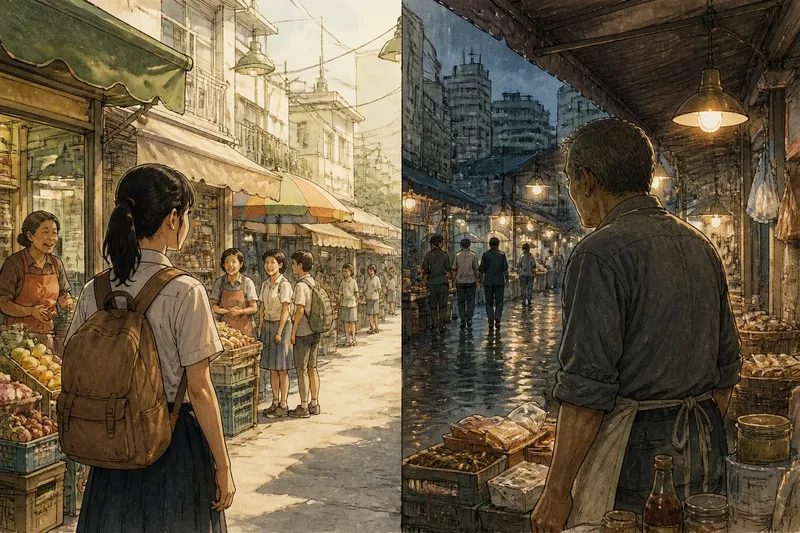
Say you choose two films set around the same neighborhood market. In the first, imagine the story follows a young person who visits after school and sees the stalls as a place to linger. Note which corners feel inviting and who makes that comfort possible. Those observations give the second film a point of comparison without requiring either story to match.
5. Use the pause to reset, not to review
Between films, take a short break. Stretch, refill a glass of water, or open a window. A pause helps the second film arrive on its own terms instead of feeling like an immediate continuation of the first.
If you want a prompt, write down one detail that stayed with you and one question you still have. Avoid deciding which film is “better” before the pair is complete. The purpose is to notice how two storytellers make a shared kind of place mean something different.
Keep the transition simple. There is no need to read a long plot summary or search for an explanation of every image. If a detail is confusing, leave it open for now; the second film may sharpen your sense of what you noticed, even if it does not resolve the question.
6. Let the second film revise the first
In the second film, look for a change in access and emphasis. Is the same kind of place now seen from outside, from a worker’s position, or through someone who wants to leave? Does the film make ordinary routines feel protective, restrictive, or both? The setting may resemble the first film while the people’s relationship to it shifts.
Imagine the companion film follows an older vendor at that market as a change in the neighborhood threatens the stall. The same rows of goods that felt like a welcoming after-school refuge may now register as labor, obligation, and a fragile connection to regular customers. That contrast does not cancel the first film’s view; it shows how a place can hold different meanings at once.
Let the second film make you reconsider a detail from the first. Perhaps a doorway that seemed open now feels guarded, or a quiet corner looks less peaceful once you have seen who is expected to keep it orderly. This back-and-forth is the reward of the pairing: one viewpoint makes the other more legible.
7. Which questions help a first same-place double feature?
How do I choose films if I am new to East Asian cinema?
Start with films available through a library, a trusted streaming catalog, or a local cinema program, then read short descriptions for setting and viewpoint. Choose stories whose basic situation sounds clear to you, rather than trying to select titles for their reputation.
Do both films need to come from the same country?
No. A shared kind of place can make a useful pairing across national cinemas, though differences in language, social customs, and filmmaking tradition may add another layer to notice. For a first double feature, keep the central comparison simple so the setting remains your anchor.
Should I watch the shorter film first?
Not automatically. Put first the film that gives you a clear sense of the place, or the one you are most eager to see. If you expect the darker film to dominate your mood, placing it second can leave the evening on a more open note.
What if the films feel too similar?
Shift your question from plot to viewpoint: who has power, who is welcome, or who does the film ask you to follow? If the films still feel interchangeable, save one and choose a companion with a more obvious difference in mood or perspective.
8. Keep the plan low-cost and the notes light
Borrow discs or streaming access through a public library when available, check whether a local cinema is showing a suitable pair, or use services you already have. Avoid paying for a new subscription just to preserve a perfect theme. A close match is more useful than an expensive one.
For notes, a scrap of paper or the notes app on your phone is enough. Record the shared place, each film’s viewpoint, and one detail that changed meaning after the second viewing. You can also skip notes entirely and talk the pairing through with a friend. The aim is attention, not documentation.
It is not worth trying to identify every location, decode every symbol, or build an exhaustive watch list before pressing play. Those tasks can crowd out the simple pleasure of seeing a familiar kind of place treated differently. Let curiosity lead, and leave room for uncertainty.
9. Carry one new question into your next pairing
After both films, return to the question you chose at the start. Did the pair answer it, complicate it, or make a different question more interesting? A few sentences are enough. You might find that one film treated the place as a refuge while the other showed the cost of staying there.
That small reflection can guide your next same-place double feature. If a neighborhood gave you the richest contrasts, try a station or a family home next time. If the viewpoints mattered more than the location, look for a pair centered on people with different relationships to the same community.
A first same-place double feature is most satisfying when the second film does not merely repeat the first, but changes what you notice about it. Choose accessible titles, give each one room, and follow one question from the first setting to the second. The next time a film returns to a familiar street or room, you may recognize that a place is never only a backdrop; it can be the story’s quietest point of view.