Subtitles or Dubbing: Choosing Your Way into a Film
Subtitles or dubbing shape what you hear and notice. Compare the options and choose a track that fits the film, your language comfort, and your viewing setup.
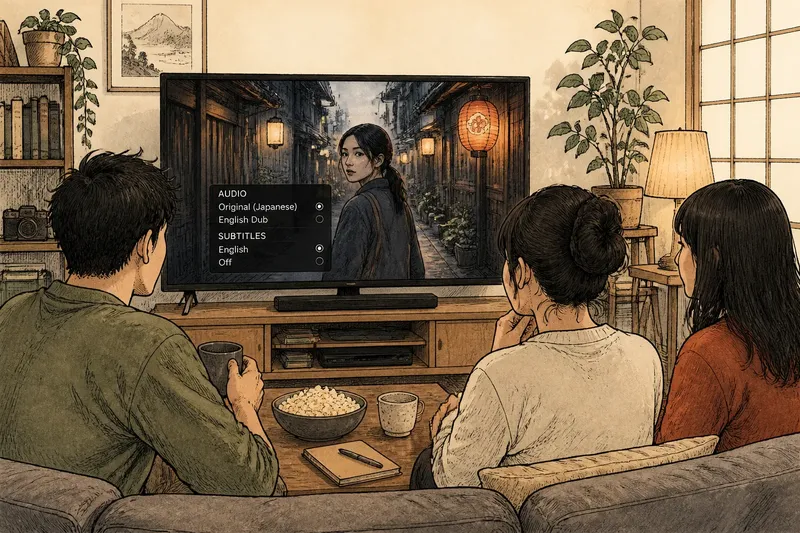
The most common mistake with subtitles or dubbing is treating one as the correct way to watch. For an East Asian film, that can leave you judging your viewing habits instead of noticing the actors, images, and sound. The choice changes what reaches you directly and what asks for more attention.
What changes between subtitles and dubbing?
Subtitles let you hear the original-language voices while reading a translation. Dubbing replaces those voices with dialogue recorded in another language. Both can make the story accessible, but they shape the experience differently.
With subtitles, you hear the original performance: its pace, pauses, and vocal texture. Your eyes also need to move between the text and the image, so a quick gesture or a detail at the edge of the frame can be easier to miss.
Dubbing lets you follow dialogue in a language you understand while keeping your eyes on the image. That may suit a busy scene or a film with intricate compositions. In exchange, you hear a separate performance, whose timing and emotional tone may not line up with the actor on screen.
Will subtitles pull me away from the picture?
They can, especially when dialogue comes quickly, speakers overlap, or the subtitles sit across a busy part of the image. But you do not have to read every line with equal attention. Once you understand who is speaking and what is happening, a brief glance may be enough.
Consider the scene’s demands. A quiet close-up gives you room to read and watch a face; a crowded market scene may ask more of your eyes. If you are new to subtitles, try a short scene and adjust the display if the words are difficult to read or cover important action.
When might dubbing suit the film?
Dubbing may be useful when reading feels tiring, when you are watching with a child, or when a companion cannot comfortably follow subtitles. It can also leave more attention for movement, composition, and changes in the setting.
Listen for how the new voices fit the scene. A dub may feel natural when the phrasing suits the character and the moment. It may distract you if an awkward exchange sounds too polished or a line ends before the actor’s mouth stops moving.
Voices are only one part of a film’s sound. Music, room tone, street noise, and silence all help shape a scene. If you choose a dub, notice whether those elements still carry the mood; if the original vocal performance matters most to you, subtitles may be a better fit.
How do I choose subtitles or dubbing for an East Asian film?
Start with the film and the viewing situation, not a broad assumption about Japanese, Korean, Chinese, or another cinema. A restrained drama may draw attention to pauses and vocal inflection; a fast-moving comedy may make dialogue that is easy to follow more useful. The individual film matters more than its national category.
Say you begin a subtitled family drama and notice that you are reading every line while missing the actors’ expressions. At a natural pause, you switch to an available dub. Now you can watch the faces and blocking more closely, but you no longer hear the original vocal performance. The tradeoff is clear: more direct access to the image, less access to the source voices.
If you are watching with others, agree on a track before the film starts. You can sample the opening scene, then make one considered change if the dialogue or image is hard to follow. Repeatedly switching back and forth to compare individual lines is usually not worth the effort; it can turn the scene into a technical exercise.
What should I check before pressing play?
Streaming menus may offer several audio tracks and subtitle settings. Check what is available before settling in, since labels and options vary by service and release.
- Original audio: Check whether the original-language track is available. If hearing the source performance matters, choose it; if it is missing, select a familiar-language dub or another available track.
- Dub language: Check whether a dub uses a language you understand comfortably. If it does, try it when reading would tire you; if not, use subtitles in a language you can follow.
- Subtitle language: Check whether you can read the translation without stopping to decode it. If you can, keep that setting; if not, select another available language or use a dub.
- Subtitle size and position: Check that the words are legible and do not cover faces or important action. If they are hard to see, adjust the display where possible; if no adjustment is available, try a different screen or track.
- Captions for sound: Check whether you want written descriptions of music, noises, or speaker changes as well as dialogue. If those cues help you follow the scene, turn on captions if offered; if dialogue alone is enough, leave them off.
- Room and screen: Check whether everyone can see the subtitles and hear the dialogue from their seats. If not, change seats, screen, or volume where practical; if the setup cannot be adjusted, consider a dub or a different viewing arrangement.
What do viewers often ask about subtitles and dubbing?
Do subtitles preserve the original performances?
They let you hear the original voices, though the translation shapes what you understand. Subtitles preserve the vocal sound, not every nuance of the spoken language.
Does dubbing change the film?
Dubbing adds a new vocal performance and may shift timing, tone, or comic rhythm. The images and other soundtrack elements remain, but the voices you hear are different.
Can I switch between subtitles and dubbing?
You can switch if the service provides both options. Try a change at a natural pause, then follow the new track rather than comparing each line.
Should I choose based on the film’s language or country?
Let the individual film and your viewing situation guide you. The central choice is whether you want to hear the original vocal performance or follow dialogue in a familiar language while watching the image.
For subtitles or dubbing, the useful question is what each version lets you notice in this particular film. A quiet performance may reward hearing the original voices, while a visually dense scene may be easier to follow with dialogue in a familiar language. Check the available tracks, make a deliberate choice, and give the scene time to speak.