The Period-Film Authenticity Trap: How to Read Historical Detail
Learn how to judge period-film authenticity beyond convincing costumes and sets, separating visual persuasion from historical claims as you watch.
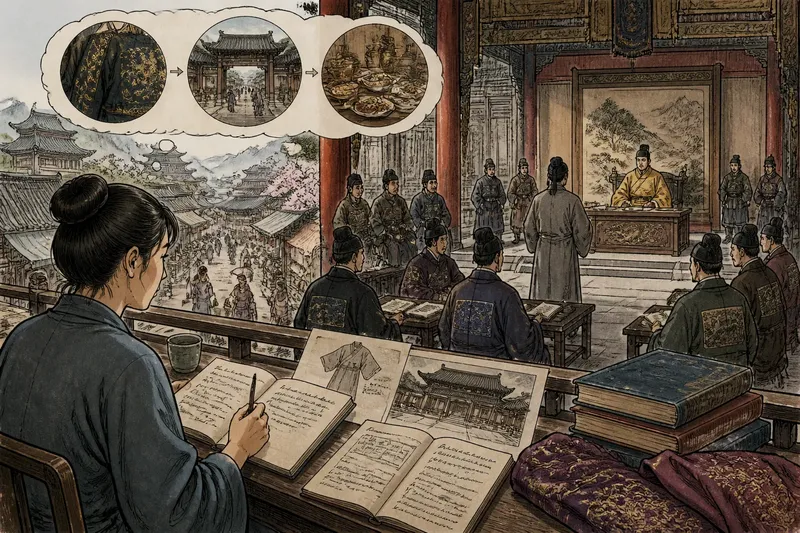
The most common mistake in judging period-film authenticity is treating a convincing robe, street, or palace as proof that the whole story is historically accurate. That shortcut can cost you a richer viewing experience: you may accept visual confidence as evidence, or dismiss a film’s craft because one detail seems questionable. A better habit is to ask what each detail is doing, then separate what the film shows from what it claims.
Across East Asian cinema, historical dramas may draw on court records, popular legends, theatrical conventions, or invented worlds. A film can be meticulous about fabric and architecture while reshaping events for drama. Another may use stylized sets yet offer a pointed account of power or social life. A simple three-session plan makes it easier to notice these layers without turning movie night into an exam.
Why does period-film authenticity feel so convincing?
Viewers encounter the past through selected details. A weathered wooden gate, a formal bow, the arrangement of a meal, or the sound of a street can make a scene feel inhabited. These choices create a sense of place before the story has made any historical argument. That impression is powerful, but it is not the same as documentation.
Film also directs attention. A close view of embroidered sleeves may invite admiration; a crowded market may suggest a whole society through a few faces and gestures. The camera gives those details weight, while music, performance, and editing encourage us to accept the scene’s emotional logic. None of that automatically tells us whether the customs, chronology, or social roles match a particular period.
Even the word “authentic” can blur separate questions. Does a costume resemble surviving garments? Does dialogue reflect the language of the time? Does the plot follow known events? Does the film convey how different people might have experienced those events? A film might answer one question persuasively and leave another open.
What should you notice in the first session?
In your first session, watch without pausing to verify details. Keep a small note beside you and record only moments that make a clear claim about the past. That could be a character explaining a rule, a scene presenting a ceremony as customary, or a political conflict framed as the cause of a major change.
Keep notes about claims separate from notes about style. “The room is arranged around a raised seat” describes what appears on screen. “Only people of a certain rank could enter this room” is a historical claim. The second may be true, plausible, simplified, or invented; the film’s visual authority alone cannot settle it.
Also notice whose point of view organizes the scene. A court-centered story may show a kingdom through the concerns of officials and rulers. A family drama may make household labor central while leaving state politics at the edges. This is not necessarily an error. It is a choice that shapes which parts of the past feel important.
How do you check one detail in the second session?
Use your second session to choose one or two details from your first-session notes. Ask a narrow question rather than searching for a verdict on the entire film. “Were these garments associated with this rank?” is easier to investigate than “Is this film historically accurate?” Narrow questions help you see where evidence begins and where interpretation takes over.
Look for sources suited to the detail. A museum collection or catalog can help with objects and clothing. A reputable history book may clarify institutions or chronology. A filmmaker’s interview can explain artistic intention, but intention is not evidence that an event happened as shown. If sources disagree or the subject is complex, keep the uncertainty visible in your notes.
Do not expect a single surviving object to represent everyone in a society. Preserved clothing, official documents, and palace architecture can tell us a great deal, yet they often record the lives of people whose possessions or activities were more likely to be kept. A film’s focus on elite spaces may be visually legible while still offering only a partial social picture.
Say you are watching an invented court drama in which a servant enters a council chamber and speaks freely to a ruler. In your first session, you note that the scene presents this access as ordinary. In the second, you consult a general history of court protocol and find that access depended on role and circumstance. You then write down both the source’s limited point and the film’s broader dramatic choice: the scene may compress a complicated practice to keep the story moving, or use the moment to imagine a challenge to hierarchy. The result is a qualified reading, not a pass-or-fail score.
What can costume and setting tell you—and what can’t they?
Costumes and sets can reveal the filmmakers’ priorities. Repeated colors may distinguish political groups; a carefully controlled silhouette may make rank readable at a glance. A set can also create an emotional landscape: a narrow corridor may make authority feel oppressive, while an open courtyard can give a gathering a ceremonial quality.
Those choices communicate meaning whether or not they reproduce a specific historical object. Ask not only, “Could this garment have existed?” but also, “What does the film want me to infer from it?” If a character’s clothes change after a shift in status, the costume design is narrating. Its clarity may come from visual storytelling rather than exact period practice.
Setting works similarly. A film may combine architectural features from different places or periods to create a coherent screen world. That combination can be an artistic choice, a production constraint, or a clue that the story is not claiming documentary precision. Unless the film or reliable sources clarify the choice, avoid treating every detail as a transparent window onto a single historical moment.
Which historical claims do viewers often ask about?
Does a period film need to reproduce history exactly?
No single standard fits every film. A work may aim for close reconstruction, freely adapt a source, or use a historical setting to explore themes that reach beyond its era. Judge the film’s specific claims and stated approach rather than assuming every period story promises the same kind of accuracy.
Can a film be visually accurate but socially misleading?
Yes. Carefully rendered objects can sit inside a story that gives little attention to labor, regional differences, or people outside elite circles. Ask whose lives are visible and whose are missing; the answer helps define the film’s historical perspective.
Should an anachronism ruin the viewing?
Not automatically. A detail outside its period may be an oversight, a deliberate simplification, or part of a stylized approach. Note it, check whether it changes the film’s larger claim, and decide how much weight it deserves.
How can I tell whether the film is based on a legend?
Check the opening or closing credits, official synopsis, and reliable writing about the source tradition. A legendary story can preserve cultural memory without serving as a straightforward record of events. Treat its historical value and its historical evidence as related but distinct questions.
What should you do in the third session?
In your third session, revisit one scene that combines a striking image with a strong historical claim. Watch it again with your notes, then write two short sentences: one about what the scene literally shows, and one about what it asks you to believe. If you checked a source, add what that source can actually support. This keeps observation, interpretation, and evidence from collapsing into one impression.
Then consider what the scene gains from its version of the past. Does it make a hierarchy feel natural, expose its costs, or turn an uncertain event into a clean moral conflict? A historical film is not only a container for period details. Its choices about what to show, omit, compress, or invent shape the viewer’s sense of history.
What is not worth the effort is pausing over every utensil or costume seam to hunt for a mistake. That can distract from the film’s rhythm and make tiny uncertainties seem more important than its central claims. Save detailed checking for an element that matters to the story or has changed how you read a character.
By the end of the third session, period-film authenticity should feel less like a pass-or-fail verdict and more like a set of questions. Notice the image, identify the claim, and seek evidence only where it helps. That habit lets you appreciate craft without mistaking persuasion for proof—and lets you enjoy a film’s imaginative use of the past even when its history needs qualification.